Table of Contents
- Assess Your Brush Clearing Project Before You Start
- Best Tools for Clearing Brush by Size and Type
- Clearing Brush by Hand: When and How
- Step-by-Step Process for Clearing Overgrown Land
- What to Do with Brush After Clearing
- How to Prevent Brush from Growing Back
- Common Mistakes to Avoid When Clearing Brush
- Frequently Asked Questions
Last Updated: October 18, 2026
Assess Your Brush Clearing Project Before You Start
Before you rent equipment or pick up a chainsaw, take time to understand what you're actually dealing with. The best way to clear overgrown brush depends entirely on what's growing on your property, how much of it there is, and what terrain you're working with. Getting this assessment right saves you money, time, and frustration.
Check property boundaries and utilities
Start by marking your property lines. You don't want to clear brush on your neighbor's land by accident. Walk the perimeter with a property map or survey document if you have one.
Next, call 811 before you dig or cut anything. This free service locates underground utilities like gas, electric, and water lines. It takes a few days, so plan ahead. Hitting a buried line can be dangerous and expensive.
Evaluate vegetation type and density
Walk through the overgrown area and identify what's actually there. Are you dealing with dense weeds, tangly vines, small saplings, or woody growth? Different vegetation needs different tools.
Take photos. Note whether the brush is scattered or thick. Check if there are large trees mixed in. Dense brush that's tightly packed takes longer to clear than sparse, scattered growth.
Measure your acreage and terrain
Estimate the size of the area you need to clear. Even a rough calculation helps you pick the right equipment. A quarter-acre lot needs different tools than a two-acre property.
Look at the terrain too. Is it flat, sloped, or rocky? Wet or dry? Uneven ground makes some equipment harder to use. Rocky soil can damage blades and wear out equipment faster.
Best Tools for Clearing Brush by Size and Type
Different tools handle different jobs. Matching the right tool to your vegetation type is the fastest way to get results.
Hand tools for selective clearing
Hand tools work best when you're clearing small areas or being selective about what comes out.
Pruning shears handle small branches and vines up to about half an inch thick. A hatchet or axe works for slightly larger branches. A shovel helps dig out roots and remove debris.
Hand clearing takes time and physical effort. It's practical for small yards or light underbrush, but it's exhausting for dense brush over a large area.
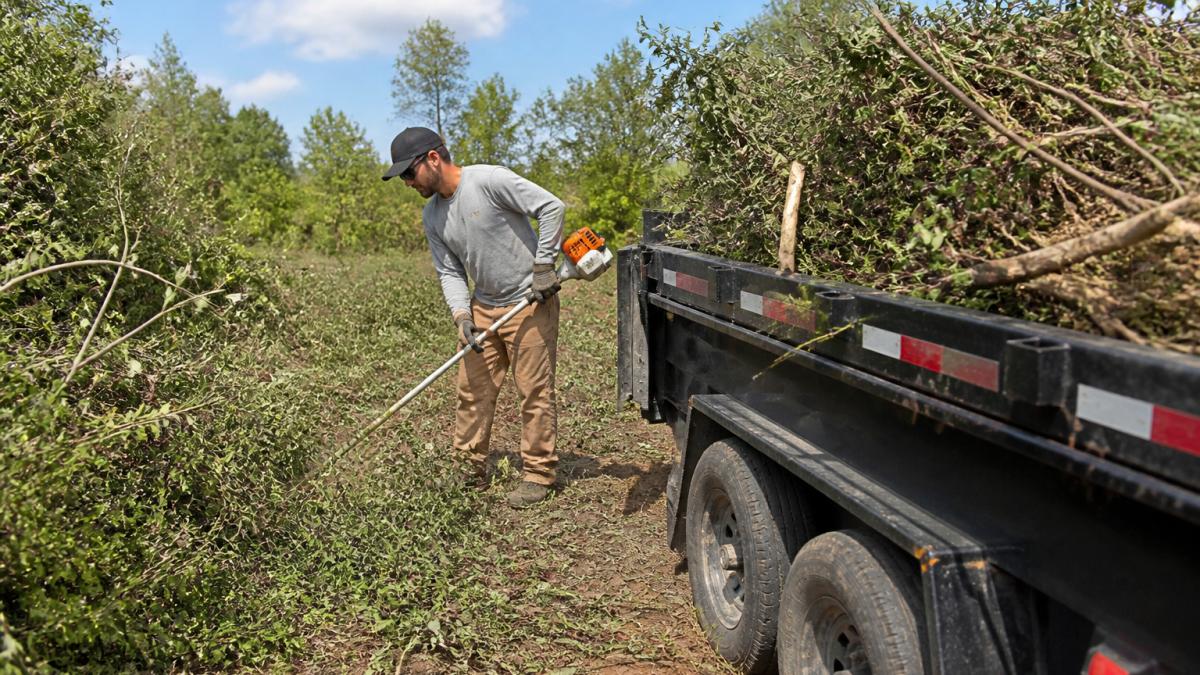
String trimmers and brush cutters for weeds and light growth
A string trimmer (also called a weed trimmer or weed whacker) cuts weeds and light brush up to about quarter-inch thick. It works fast on open areas with scattered growth.
A brush cutter is a heavier-duty version with a solid metal blade instead of a string. It handles thicker growth, small saplings, and tangly vines.
Both tools are handheld, so they work well for edge areas, fence lines, and places you can't fit larger equipment. They're also good for clearing brush around existing trees or structures you want to keep.
Chainsaws and pole saws for woody growth and saplings
A chainsaw cuts through woody growth, small trees, and thick branches quickly. Pole saws let you reach higher branches without climbing.
Chainsaws are powerful but require fuel, maintenance, and skill to use safely. They're loud and physically demanding. Use them for saplings, fallen trees, and branches thicker than two inches.
Pole saws are lighter and easier to control. They're better for branches overhead and work on smaller saplings. They're less powerful than chainsaws but safer for most homeowners.
Brush mowers for larger areas
A brush mower is a tractor-mounted cutting head that chops brush, small trees, and woody growth into chips. It's the fastest option for clearing large areas with dense brush.
Brush mowers work best on relatively flat terrain. They handle growth up to about three inches thick. The result is finely chopped material that can be left as mulch or collected.
Renting a brush mower with an operator costs more upfront, but it saves enormous amounts of time on larger properties.
Clearing Brush by Hand: When and How
Hand clearing works when you have time, physical capability, and a small enough area. It's the most precise method and gives you complete control over what stays and what goes.
Manual clearing techniques and best practices
Start at the edge and work inward. Cut lower branches first, then move to taller growth. This prevents debris from tangling around your feet.
Cut branches into manageable pieces. Drag or carry them to a staging area where you can chip them or haul them away.
For vines and underbrush, cut as close to the ground as you can. Pull out loose debris with your hands or a rake.
Work during daylight. Stop if you're tired. Hand clearing is exhausting, and fatigue leads to mistakes and injuries.
Safety gear and protective equipment
Wear long sleeves and long pants. Brush has sharp edges and hidden thorns.
Wear heavy work gloves. Leather or reinforced synthetic gloves protect your hands from cuts and splinters.
Eye protection matters. Wear safety glasses. Small branches and debris fly up when you're cutting. Protect your eyes.
Wear sturdy boots with ankle support. Steel-toed boots are better. You're working on uneven ground with sharp tools and heavy debris.
For power tools, wear a dust mask or respirator. Chainsaw work requires hearing protection and a hard hat.
Step-by-Step Process for Clearing Overgrown Land
A systematic approach prevents you from getting lost in the work and helps you manage debris effectively.
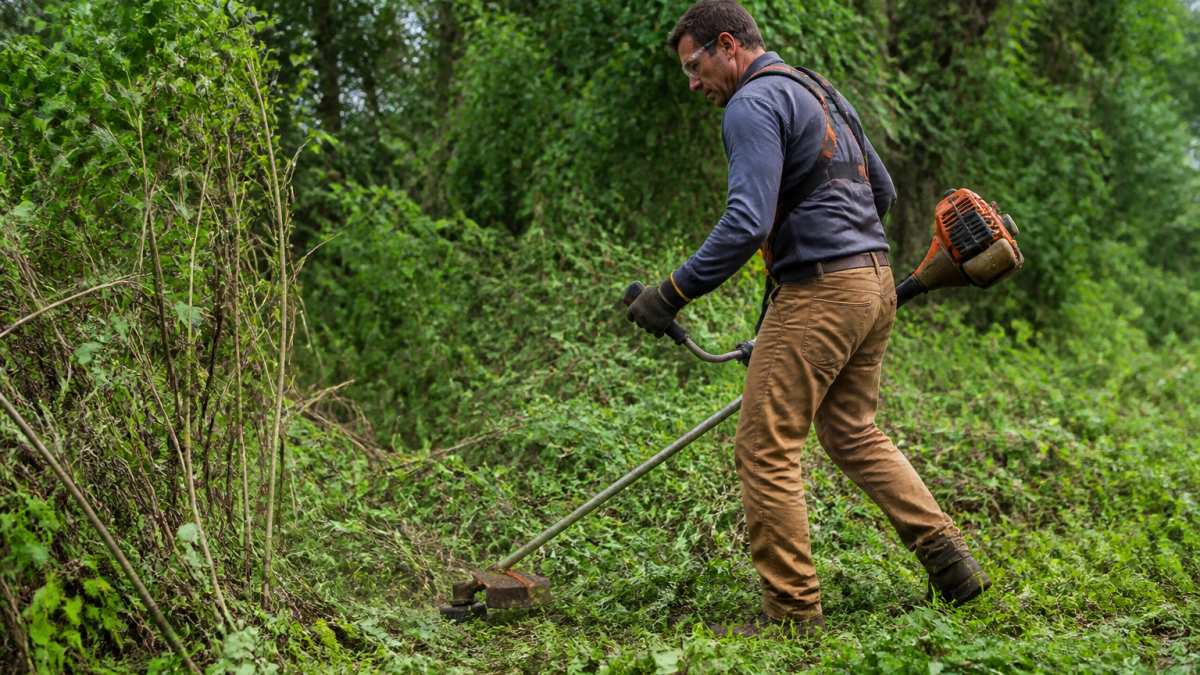
Step 1: Clear the perimeter and mark hazards
Start by clearing the edges of the area. This gives you defined boundaries and room to move around.
Look for hazards as you go. Mark dead trees, unstable branches, and steep drop-offs. Note any areas where debris could roll or slide. Identify spots where utilities might run.
Clear a path around the entire perimeter. This is your work zone and your escape route if something goes wrong.
Step 2: Remove tangly vines and underbrush
Vines and underbrush tangle around larger growth and make everything harder to cut. Remove them first.
Cut vines at the base and pull them away. Don't try to remove every root right now. Just clear the tangle so you can see what's underneath.
Use a rake or hoe to clear loose debris and small branches. Pile it in your staging area.
Step 3: Cut small trees and saplings
Now that the tangle is cleared, you can see and reach the larger growth. Cut saplings and small trees.
For trees under two inches thick, a brush cutter or hatchet works. For larger growth, use a chainsaw. Cut at ground level or slightly below if possible.
Don't worry about stumps yet. Focus on removing the aboveground growth first.
Step 4: Remove stumps and grind or chip wood
Once the brush and small trees are gone, deal with what's left behind.
For small stumps, dig around the base and pull them out with a mattock or grub hoe. For larger stumps, rent a stump grinder. Grinders chew through wood quickly and leave the area ready for replanting or new growth.
Chip or mulch the branches and smaller wood. A wood chipper turns branches into chips that can be spread as mulch. A mulcher grinds everything finer.
What to Do with Brush After Clearing
You've got a pile of brush and wood chips. Now you need to deal with it.
Chipping and mulching options
A wood chipper turns branches into chips. Chips make excellent mulch for garden beds and pathways. They break down over time and improve soil.
A mulcher grinds material finer than a chipper. Fine mulch works better in garden beds and breaks down faster.
You can rent both machines by the day. Chipping takes time but saves hauling costs if you can use the chips on your property.
Brush pile disposal and hauling
If you can't use the chips, you need to haul the brush away. Brush piles can be bulky and hard to move.
Some communities accept brush at waste facilities. Check your local rules. Some places chip brush for free and give away the mulch.
For larger piles, renting a dumpster or hiring a hauling service makes sense. NexGen Dirt & Haul handles debris removal and can haul away brush piles, saving you the time and effort of managing the mess yourself.
How to Prevent Brush from Growing Back
Clearing brush is work. You don't want to do it again next year.
Ground cover and maintenance strategies
After clearing, the soil is exposed. Brush seeds and new growth move in quickly. Plant ground cover or lay mulch to slow regrowth.
Dense ground cover plants shade the soil and prevent seeds from sprouting. Native plants work well and need less maintenance. Mulch does the same thing. A three-inch layer of wood chips or bark mulch blocks most new growth.
Mow or trim the area regularly during growing season. Frequent cutting wears down regrowth before it gets established. Once or twice a month keeps brush under control.
When to clear brush and seasonal timing
Clear brush in late fall or early spring. Growth is slower then, and regrowth takes longer to establish.
Avoid clearing in spring when new growth is tender and spreads easily. Fall clearing gives you the winter advantage. Growth slows, and you have time before spring to manage regrowth.
Summer clearing works but requires more frequent follow-up maintenance.
Common Mistakes to Avoid When Clearing Brush
Learning from other people's mistakes saves time and money.
Don't skip the assessment.
Don't clear without marking utilities.
Don't leave roots in the ground if you want to prevent regrowth.
Don't ignore safety gear. Brush clearing causes cuts, scrapes, and eye injuries. Protect yourself.
Don't clear everything at once if you're doing it by hand. Work in stages.
Don't pile brush in one spot and forget about it. Manage the debris.
Don't clear during wet weather if you can help it.
Clearing overgrown brush is a real project, but it's manageable when you approach it systematically.
Frequently Asked Questions
What's the easiest way to clear overgrown brush without heavy equipment?
For small areas with light brush and weeds, a string trimmer or brush cutter is often the easiest starting point. For denser growth with small trees and saplings, hand tools like pruning shears and an axe work well for selective clearing. The key is matching your tool to the vegetation type and density. Hand clearing takes more time but gives you precise control over what stays and what goes, making it ideal for yards where you want to preserve certain plants or trees.
What tools do I need to clear thick brush and small trees?
For thick brush and woody growth, you'll need a combination of tools: a chainsaw or pole saw for cutting small trees and saplings, a brush cutter with a brush-cutting blade for dense underbrush, and pruning shears or an axe for selective work. Wear protective equipment including safety glasses, gloves, long sleeves, and sturdy boots. If you're clearing stumps, a stump grinder or skid steer with a grapple can remove them efficiently. Start with hand tools to assess the density, then move to powered equipment as needed.
How do I keep cleared brush from growing back?
Regrowth prevention depends on your goals. For permanent clearing, remove stumps and roots completely, then apply ground cover or mulch to prevent new seedlings. For areas you want to maintain, mow or trim regularly during growing season to stop saplings and weeds before they establish. Timing matters: clear brush in late fall or early spring before new growth starts. Consider what vegetation you want to encourage on the cleared land, whether that's grass, garden beds, or native plants that naturally suppress brush regrowth.
What should I do with brush after clearing it?
You have several options depending on the brush type and quantity. Small branches and brush can be chipped into mulch for garden use or landscape projects. Larger wood can be split for firewood if it's suitable. For significant brush piles, hauling to a local yard waste facility is often the most practical option. Some property owners burn brush piles where local regulations permit, but always check local ordinances first. If you're clearing a large area with heavy woody growth, professional hauling services can remove everything efficiently and responsibly.