Last Updated: November 15, 2026
Quick Summary
Utility trenching is worth the cost when a line needs to run underground for safety, durability and a clean look. Costs depend on trench length, depth, soil type, line count and surface restoration. Always call 811 before digging to locate existing lines.
- Call 811 and allow the required notice period before any digging begins.
- Hand-dig or pothole within the tolerance zone around each utility mark.
- Private lines like sprinkler systems and septic lines are the property owner's responsibility to locate.
- Depth requirements vary by line type and must be confirmed with local code and the utility.
- Compare quotes by checking that trench length, locating, permits and surface restoration are all listed.
Table of Contents
- What Utility Trenching Involves and Which Lines Get Installed Underground
- Locating Underground Utilities Before Any Digging Starts
- Trench Depth, Width and Clearance Requirements for Utility Lines
- Trenching for Electrical Lines and Water Line Trenching
- Manual Versus Mechanical Trenching and Directional Boring Compared
- What Drives Utility Trenching Cost and How to Estimate It
- Questions to Ask Before Booking Your Utility Trenching Crew
- Frequently Asked Questions
What Utility Trenching Involves and Which Lines Get Installed Underground
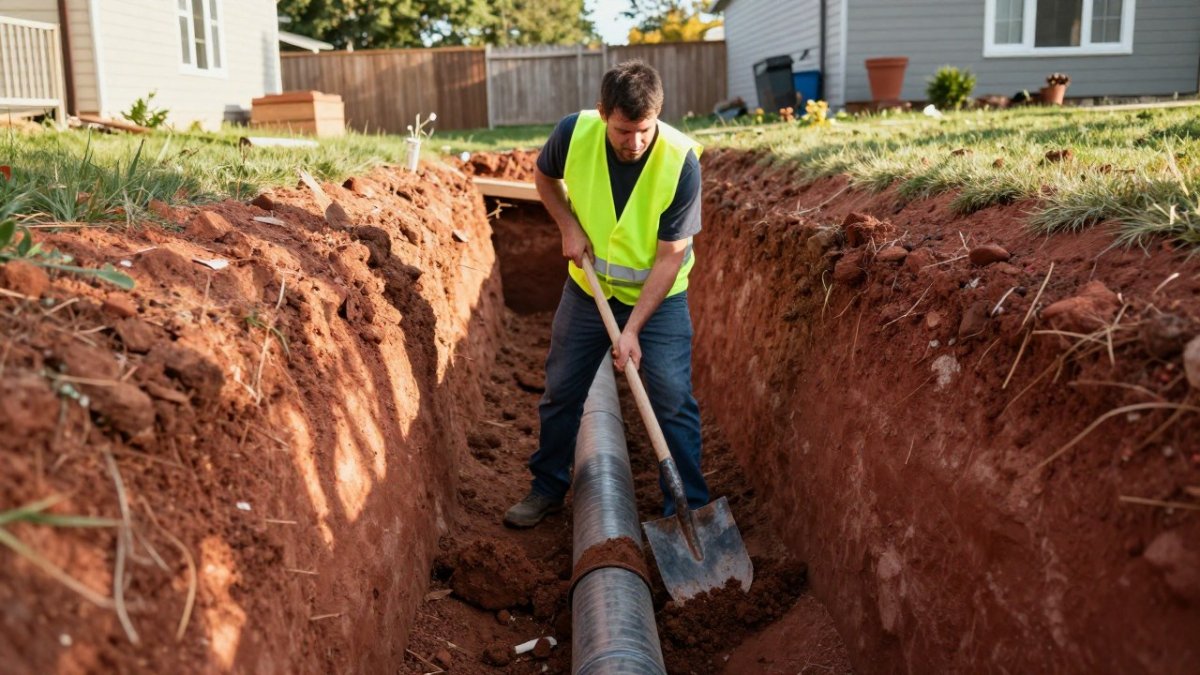
Utility trenching is the process of digging a narrow channel in the ground so that electrical, water, gas, sewer or communication lines can be laid below the surface. A trench that is too shallow, too narrow or poorly backfilled can cause problems years later.
The way the ground is graded and backfilled affects how well the line stays protected and how well the surface drains after the work is done.
The most common lines installed underground on residential properties include:
- Electrical service lines running from the meter or a detached garage or shed
- Water lines feeding a new irrigation system, outbuilding or addition
- Sewer and drain lines connecting to the main line or a septic system
- Gas lines for a new appliance, fire pit or outdoor kitchen
- Communication lines for internet, phone or cable service
Each line type has its own rules for depth and separation, which is why a single trench rarely serves every purpose.
Locating Underground Utilities Before Any Digging Starts
Striking a buried utility is the single most expensive and dangerous mistake in a trenching project. The pre-dig workflow below is the sequence most experienced crews follow, and it is worth treating as a checklist rather than a formality.

Step 1: Confirm permits and utility requirements. Before any locate request, confirm what permits the job requires and whether the serving utility has its own locate or inspection process. Some utilities require a separate request or a pre-construction meeting for new service lines, and permit conditions can specify the locate window.
Step 2: Submit the 811 request. Call 811 or submit the request online before digging, and allow the notice period your state requires. The request routes to the utility companies that own lines in the area, and each member utility is responsible for marking its own facilities.
Step 3: Wait for the marks and the positive response. Do not dig until the locate window has passed and every member utility has responded, either by marking or by clearing the area.
Step 4: Verify the marks against your plan. The marks show where the utility believes its lines are, not necessarily where your trench should go. Walk the route, compare the marks to the plan, and adjust the trench alignment if the marks create a conflict.
Step 5: Locate private lines. The 811 service covers public utilities up to the meter or service point. Private lines, such as sprinkler systems, yard lights, detached garage feeds, septic lines, and private gas or water lines beyond the meter, are the property owner's responsibility.
Step 6: Hand-dig and pothole near marks. Within the tolerance zone around each mark, use hand tools or vacuum excavation rather than a trencher or excavator. Potholing confirms the actual depth and position of the line before mechanical digging begins.
Step 7: Re-verify if conditions change. Marks are only valid for the locate window, and they can be washed out by rain, disturbed by traffic, or covered by spoil. If the marks are damaged or the work is delayed beyond the ticket window, submit a new request before continuing.
What to do if a line is struck. Stop work immediately, move the crew away from the area, and call 911 if there is a gas leak, fire, or injury. Notify the affected utility and the local One Call center, and do not attempt to repair the line yourself.
Watch out: a locate ticket is not a guarantee that no lines exist. Check whether drainage permits and stormwater rules also apply before you start any digging.
Trench Depth, Width and Clearance Requirements for Utility Lines
Trench depth and width are set by three things: the utility type, the surface above the trench, and the local code or utility company standard that governs the installation. No single number applies to every job. Always confirm the final numbers with the local permitting office and the serving utility before digging.
Electrical lines. Minimum burial depths for electrical lines are set by the National Electrical Code and local amendments. Confirm the required depth for your installation with the local inspector before digging.
Water lines. There is no single national depth for water service lines. Many jurisdictions require the line to sit below the local frost line to prevent freezing. Water lines also need separation from sewer lines under the local plumbing code and utility standard.
Sewer and drain lines. Sewer lines must maintain gravity flow to the main or septic tank. The local plumbing code and its amendments set minimum cover and slope requirements, so confirm them with the local inspector.
Gas lines. Natural gas and propane lines are governed by the applicable fuel gas code and the serving utility's standards. Confirm the minimum cover and separation requirements with the utility before digging.
Communication lines. The serving telecom or cable company sets its own burial standard for fiber, coax and telephone lines, so confirm it before digging.
Width and bedding. A trench that is too narrow cannot be properly bedded and compacted. Trench width should be wider where multiple lines share a trench or where the pipe diameter requires it. Bedding material, usually sand or fine aggregate, is placed under and around the pipe to protect it from rocks and to allow uniform compaction.
Clearance from other structures. Lines must also maintain horizontal clearance from foundations, pools, and other utilities. Local code controls the minimum distance from a foundation wall for water and sewer lines. Where multiple utilities share a trench, they must be separated horizontally and vertically so that a failure in one does not damage another.
Watch out: depth requirements can change when the surface above the trench changes. Plan the route with the final surface in mind, not just the current grade.
Trenching for Electrical Lines and Water Line Trenching
Electrical trenching is common when a detached building needs power. The conduit, wire type and burial depth must match the code for direct-buried or conduit-protected installations, and the trench should be backfilled with clean material and compacted in layers.
Water line trenching follows similar steps but adds concerns about freezing and pressure. In colder parts of the country the line must sit below the frost line, or it needs insulation to prevent freezing.
Water Line Trenching Considerations
Water lines need a stable, even bed under the pipe so that it does not sag or crack under the weight of the backfill. Rocky or uneven soil should be removed or covered with sand before the pipe is laid. Shut-off valves and access points should be placed where they can be reached later without digging up the entire yard.
Many homeowners also overlook the surface restoration. Grass, sod or landscaping that is disturbed during a water line trench usually needs to be leveled and reseeded or replaced, and the way the trench is graded can change how water runs off the property.
Manual Versus Mechanical Trenching and Directional Boring Compared
Trenching can be done by hand, with a mechanical trencher or excavator, or by directional boring, which drills a path underground without cutting an open trench. Each method suits different jobs.
| Method | Best For | Typical Disruption | Relative Cost |
|---|---|---|---|
| Manual digging | Short runs, tight spaces, small lines | Low, but slow | Lowest equipment cost, highest labor time |
| Mechanical trencher | Long, straight runs in open ground | Moderate, creates an open trench | Moderate |
| Excavator trenching | Deeper trenches, rocky or mixed soil | Higher, wider disruption | Higher |
| Directional boring | Crossing driveways, roads or landscaping | Low at the surface, two small pits | Often higher per foot |
Manual digging is practical for short runs but can become costly in labor if the trench is long. Mechanical trenching is faster on open lawns but disturbs more of the yard. Directional boring avoids cutting through a driveway or patio but needs a crew with the right equipment and a clear underground path.
What Drives Utility Trenching Cost and How to Estimate It
Pricing for utility trenching depends on quantity, dates, and delivery. If you are weighing a crew against doing the work yourself, this cost breakdown of professional excavation versus DIY compares costs, risks and timelines. Trench length, depth, soil type, the number of lines, the need for permits, and the cost of restoring the surface all affect the final figure. For a current quote on your project, check the NexGen Dirt & Haul website or text a photo of the site. You can also review small excavation, yard leveling and grading services before requesting pricing.
To compare quotes fairly, ask each provider to list the trench length and depth, the line types, whether locating and permits are included, and how the surface will be restored. A lower price that leaves out restoration or locating may cost more in the end.
Questions to Ask Before Booking Your Utility Trenching Crew
Before you book a crew, know what you want done and where the lines will run. Clearing brush and overgrowth from the route first can make the dig easier, and you can send project photos for brush removal and small-lot clearing to NexGen Dirt & Haul. Have a clear sketch of the route, mark it on the ground, and confirm the 811 locate is scheduled. Clear communication about the goal, whether a new service line, an extra outlet in a shed or a sprinkler feed, lets the crew start work right away. If you also need fill or base material, see local dirt, gravel and aggregate delivery in Norman, Moore and OKC.
Ask the crew these questions before work begins:
- Will you call 811 and confirm the locate before digging?
- Do you handle permits, or should I contact the local office myself?
- What trench depth and width will you use for each line type?
- How will the backfill be compacted, and how will the surface be restored?
- Who will repair any damage to landscaping, sprinkler lines or driveways?
- Can you show examples of similar residential trenching work?
If you have a trenching project in mind, text us a photo of the area to request a free quote.
Frequently Asked Questions
How much does it cost to trench a power line?
Costs for trenching a power line depend on trench length, soil conditions, depth required, surface restoration, and whether permits and utility locates are included. NexGen Dirt & Haul does not publish fixed trenching rates in this article, so pricing depends on the specifics of your job. Ask for an itemized quote that separates excavation, locating, backfill, and cleanup so you can compare bids accurately. Check current pricing on the NexGen Dirt & Haul website or request a free quote by texting a photo of the site.
How deep should a trench be for utility lines?
Required trench depth depends on the utility type, the governing code, and the conditions of the site, so the local inspector or utility owner sets the final figure. Many installations for residential service are placed at a shallower depth than main lines, but this is not a universal rule. Confirm the required depth and separation from other utilities before excavation starts. A contractor who checks these requirements first avoids having to re-dig the trench later.
How do contractors locate existing underground utilities before digging?
Contractors request utility locates through the 811 call-before-you-dig service, which notifies member utilities so they can mark their lines. Locators then use electronic equipment to trace buried lines and paint or flag the locations on the ground. Private lines such as irrigation or yard lighting often need a separate locate. Wait for the markings to be in place before any excavation begins, and keep the marks visible until the work is finished.
What should homeowners ask before hiring a utility trenching contractor?
Ask whether the contractor handles utility locates and permits, what equipment they will use, and how they will protect existing lines. Request a written, itemized quote and confirm who restores the surface after backfill. Ask how they handle unexpected site conditions such as rock or a damaged line. Check references from recent residential jobs and confirm the business carries liability insurance before work starts.
