Last Updated: October 30, 2026
Quick Summary
To figure out how much gravel do I need for a driveway, measure length times width for square footage, then multiply by depth in feet and divide by 27 for cubic yards. A new driveway needs 8-12 inches total across three layers, so a 480 square foot driveway at 11 inches comes to about 16.3 cubic yards before compaction allowances.
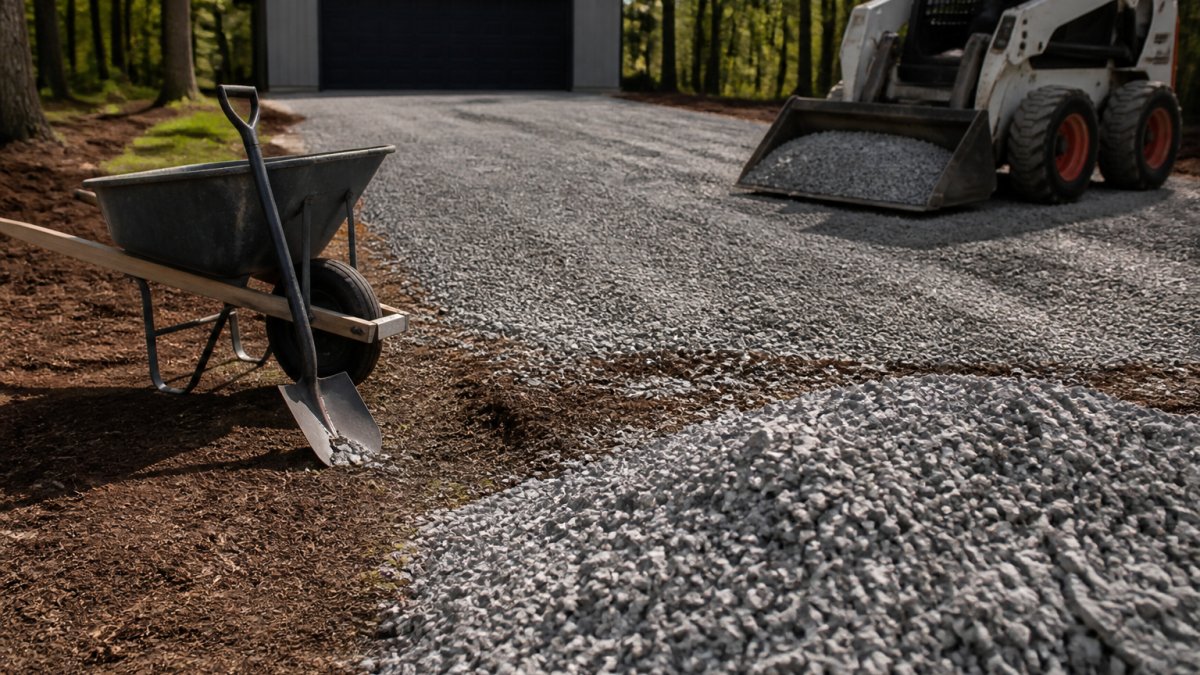
- A new gravel driveway uses three layers: 4-6 inches of base stone, 2-3 inches of crusher run, and 2-3 inches of surface stone.
- Convert cubic feet to cubic yards by dividing by 27, since one cubic yard holds 27 cubic feet.
- Add 15-20% to base and middle layers and 10% to the surface layer for compaction and settling.
- Standard crushed stone runs about 1.13 tons per cubic yard, but wet stone adds 10-15% to the weight.
- Order each layer separately so you don't overbuy surface stone or run short on base.
Table of Contents
- Start With Your Driveway Dimensions
- Gravel Driveway Depth: How Thick Should Each Layer Be?
- The Volume Formula: Cubic Feet to Cubic Yards
- Using a Gravel Driveway Calculator
- Gravel Coverage per Ton: Converting Volume to Weight
- Adjusting for Compaction, Uneven Ground, and Waste
- Gravel Driveway Cost: What Drives the Final Bill
- Get a Text-Back Quote for Your Gravel Delivery
- Frequently Asked Questions
Start With Your Driveway Dimensions
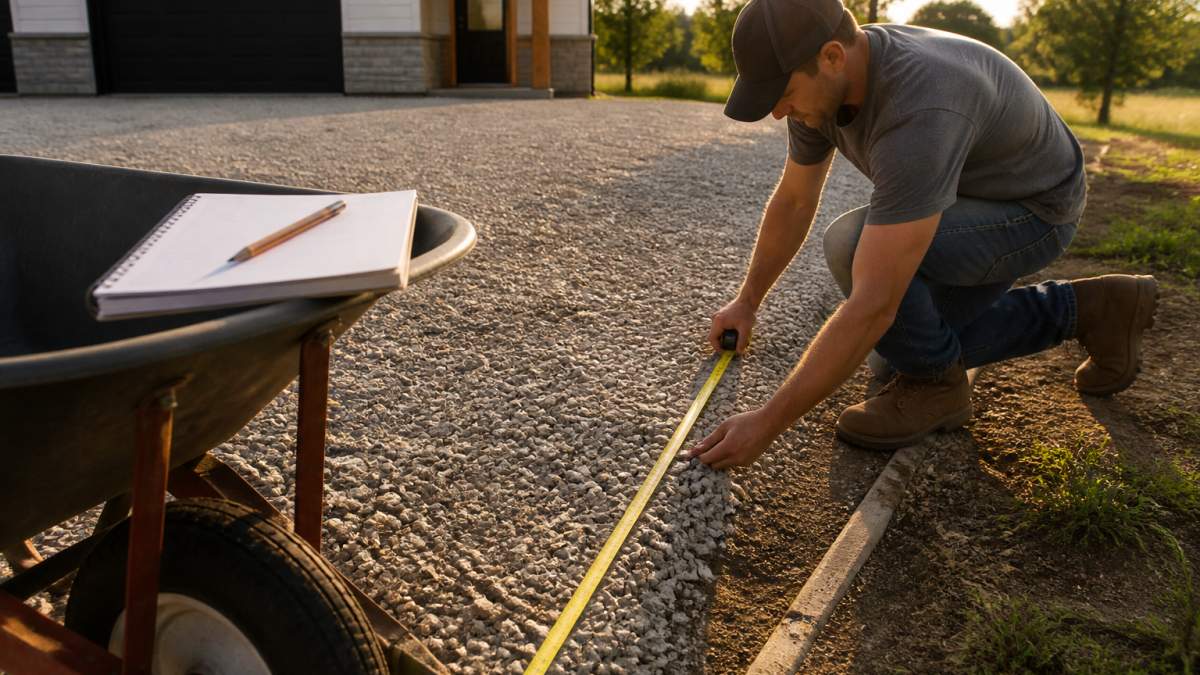
Figuring out how much gravel do I need for a driveway starts with two numbers: length and width. Multiply them and you get square footage. That's the foundation for every calculation that follows. Most folks guess wrong on this question. They eyeball the driveway, order a load, and come up short. So grab a tape measure and a notepad. The math here is simple, but the measurements have to be right.
Measuring Length and Width
Measure the full length from the garage or house edge to the street. Then measure the width at the widest point. Round up to the nearest foot. Write both numbers down in feet.
For a straight driveway, that's it. Length times width equals area in square feet. A 40-foot driveway that's 12 feet wide gives you 480 square feet. Keep that number handy.
Handling Curves, Circles, and Irregular Shapes
Curved and odd-shaped driveways throw people off. The trick is to break the shape into smaller rectangles and add them up.
- Curves: Split the curve into straight segments, measure each, then total them.
- Circles or turnarounds: Measure the diameter, then use 3.14 times the radius squared.
- L-shaped or irregular: Divide into rectangles and sum the areas.
Gravel Driveway Depth: How Thick Should Each Layer Be?
Gravel driveway depth is the number most people get wrong, and it's the one that matters most. A driveway isn't one layer of stone. It's three, and each one has a job.
Here's the standard build:
- Base layer: 4-6 inches of large crushed stone, golf-ball-sized or bigger.
- Middle layer: 2-3 inches of crusher run, which packs down hard.
- Top layer: 2-3 inches of smaller crushed stone for a smooth surface.
That's a total depth of 8-12 inches for a new driveway. For a refresh over an existing solid base, a 2-3 inch top layer is often enough. Thinner than that and the stone just disappears into the mud.
The Volume Formula: Cubic Feet to Cubic Yards
Once you have area and depth, volume is one multiplication away. Convert your depth from inches to feet by dividing by 12, then multiply by area.
Formula: Length × Width × Depth (in feet) = Cubic feet.
A 480 square foot driveway at 6 inches deep: 480 × 0.5 = 240 cubic feet. At 12 inches: 480 × 1 = 480 cubic feet.
Now convert to cubic yards, because that's how gravel is sold. Divide cubic feet by 27, since one cubic yard holds 27 cubic feet. So 480 cubic feet becomes about 17.8 cubic yards. That single conversion step is where most DIY estimates go sideways.
Using a Gravel Driveway Calculator
A gravel driveway calculator does the arithmetic for you, but you still feed it good numbers. Enter length, width, and depth, and it spits out cubic yards and an estimated tonnage.
Use one as a double-check, not a replacement for your own measurements. Most calculators assume a standard stone weight, and your material may differ.
The steps are always the same:
- Measure length and width in feet.
- Multiply for square footage.
- Multiply by depth in feet for cubic feet.
- Divide by 27 for cubic yards.
- Multiply by tons per cubic yard for weight.
If your hand math and the calculator disagree, trust your measurements and recheck the depth conversion.
Gravel Coverage per Ton: Converting Volume to Weight
Gravel coverage per ton depends on the stone. A common working figure is about 1.13 tons per cubic yard for standard crushed stone, but that shifts with material type and moisture.
Here's the rough range to plan around:
| Material | Approx. Tons per Cubic Yard |
|---|---|
| Crushed stone | 1.13-1.4 |
| Crusher run | 1.3-1.5 |
| Pea gravel | 1.2-1.4 |
| Wet stone | Add 10-15% |
Wet gravel weighs more, so order on the dry side of the range and add a little cushion. For our 17.8 cubic yard example, at 1.13 tons per cubic yard you'd need roughly 20 tons. Round up to 21 or 22 and you won't run short.
Adjusting for Compaction, Uneven Ground, and Waste
Raw volume is never the final order. Stone settles, ground isn't flat, and some material always gets lost to spillage and grading. The right allowance depends on which layer you're ordering and what the site looks like.
Layer-by-Layer Quantities for a Durable Driveway
A new gravel driveway is built in three layers, and each layer needs its own calculation because the materials differ in depth and density. Using a 480 sq ft driveway (40 ft × 12 ft) as the example:
| Layer | Depth | Volume (cubic feet) | Volume (cubic yards) | Typical Material |
|---|---|---|---|---|
| Base | 6 in | 240 | 8.9 | #3 or #4 crushed stone |
| Middle | 3 in | 120 | 4.4 | Crusher run (dense grade) |
| Surface | 2 in | 80 | 3.0 | #57 or #67 crushed stone |
| Total | 11 in | 440 | 16.3 | , |
Order each layer separately so you don't overbuy the expensive surface stone or run short on base. A refresh over an existing solid base usually needs only the 2-3 inch surface layer, which for this driveway is about 3 cubic yards.
Compaction and Settling Allowance
Crusher run and base stone pack down, losing volume. A common pattern is to add 15-20% to base and middle layers and 10% to the surface layer. For the example above:
- Base: 8.9 × 1.20 = 10.7 cubic yards
- Middle: 4.4 × 1.15 = 5.1 cubic yards
- Surface: 3.0 × 1.10 = 3.3 cubic yards
- Adjusted total: about 19.1 cubic yards
For a refresh over an existing base, 5-10% is usually enough. If the ground is soft, sloped, or rutted, lean toward the higher end.
Uneven Ground and Waste
Dips, slopes, and ruts eat extra stone. Walk the driveway and note low spots; a 1-inch dip across a 12-foot-wide section adds roughly 1 cubic yard per 100 feet of length. Spillage, grading, and edge loss typically add another 3-5%. If you're already battling ruts, fixing the cause matters more than piling on stone. Our guide on how to fix ruts in a gravel driveway walks through the full repair method so new gravel actually stays put.
Gravel Weight Variation by Material and Moisture
Tons per cubic yard vary by stone type, density, and moisture. The table below shows planning ranges; always confirm the supplier's conversion factor before you order.
| Material | Approx. Tons per Cubic Yard |
|---|---|
| Crushed stone (#57, #67) | 1.35-1.45 |
| Crusher run | 1.30-1.50 |
| Pea gravel | 1.20-1.40 |
| Wet stone | Add 10-15% |
For the 19.1 cubic yard adjusted total, at 1.40 tons per cubic yard you'd need roughly 27 tons. Round up to 28 or 29 and you won't run short. Wet gravel weighs more, so order on the dry side of the range and add a little cushion.
Gravel Driveway Cost: What Drives the Final Bill
Gravel driveway cost comes down to four things: material type, total tonnage, delivery distance, and site access. The stone itself is often the smaller part of the bill.
- Material: Crusher run costs less than decorative stone.
- Tonnage: More cubic yards means more loads and more money.
- Delivery: Distance and load count drive hauling charges.
- Site prep: Grading, clearing, and base work add labor.
Pricing depends on quantity, dates, and delivery, so there's no single number to quote here. For a detailed per-square-foot breakdown of what each part of the bill includes, see our guide on gravel driveway cost per square foot.
Get a Text-Back Quote for Your Gravel Delivery
You've got the math. Now the easy part. Text a photo of your driveway to NexGen Dirt & Haul and we'll send back a quote. Before you book, review what to check before hiring Norman dirt hauling. Pricing depends on quantity, dates, and delivery, so check our website for current prices or a quote. You can also see our local gravel, dirt and aggregate delivery options for Norman, Moore and Oklahoma City.
NexGen Dirt & Haul offers gravel driveway repair and gravel spreading for homeowners and contractors in the OKC metro area.
Frequently Asked Questions
What area will 2 tons of gravel cover?
Two tons of gravel covers roughly 200 square feet at a 2-inch depth, based on the standard estimate of about 1.13 tons per cubic yard. Coverage changes with depth: at 4 inches, those same 2 tons cover about 100 square feet. Because gravel weight varies by material and moisture, confirm the coverage figure with your supplier before you order for a gravel driveway.
How do I calculate how many tons of gravel I need for my driveway?
Multiply length by width by depth in feet to get cubic feet, divide by 27 for cubic yards, then multiply by about 1.13 tons per cubic yard. For a 40-foot by 10-foot driveway at 4 inches deep, that is about 13.3 cubic yards and roughly 15 tons before you add a compaction allowance. A gravel driveway calculator handles the math, but check the inputs yourself.
Should a gravel driveway have multiple layers?
Yes. A durable gravel driveway typically uses a 4- to 6-inch base of larger crushed stone, a middle layer of crusher run, and a 2- to 3-inch top layer of smaller stone. Each layer compacts into the one below, which is why you calculate quantities layer by layer rather than ordering one depth of mixed stone.
How deep should gravel be for a driveway?
Plan on 4 to 6 inches of compacted base plus a 2- to 3-inch top layer, so total depth lands around 8 to 12 inches for a new driveway. A refresh over existing solid gravel may only need 2 to 3 inches. Soft or poorly drained ground needs more base, and the gravel driveway depth you choose directly changes your tonnage.
Ordering gravel shouldn't feel like a gamble. NexGen Dirt & Haul takes the guesswork out with straightforward pricing, a simple text-a-photo quote process, and real equipment for professional results on small-scale dirt work and driveway repairs. Get started with NexGen Dirt & Haul and get the right amount of gravel delivered the first time.
