Last Updated: November 1, 2026
Quick Summary
To spread topsoil evenly over an uneven lawn, work in thin layers of no more than 1 inch at a time, using a lawn leveling rake to push soil into dips and a drag mat to smooth it. Fill dips deeper than 2 inches by cutting and lifting the sod first, then relaying it after filling to grade.
- Never bury healthy grass under more than 1 inch of soil at one time.
- The best soil for leveling is a blend of sandy loam, compost, and sand, not straight topsoil.
- One cubic yard covers about 324 sq ft at 1 inch deep.
- Dump small piles every 6 to 8 feet and rake in long, even strokes, changing direction each pass.
- Keep the new layer damp for the first two weeks and skip mowing for two weeks.
Table of Contents
- Why Lawns Get Bumpy and How to Spot the Real Problem
- Choosing the Best Soil for Lawn Leveling
- How Much Topsoil to Spread on Grass: Depth and Volume Math
- Preparing the Lawn Before You Spread Topsoil
- How to Fill Low Spots in a Lawn Without Smothering the Grass
- Using a Lawn Leveling Rake and Drag Mat to Spread Evenly
- Watering In, Grass Recovery, and the Aftercare Timeline
- Text a Photo and Get a Straight Quote for Your Leveling Job
- Frequently Asked Questions
Why Lawns Get Bumpy and How to Spot the Real Problem
A bumpy lawn usually has a cause you can name, and fixing that cause matters more than dumping soil on top of it. A common pattern on yard jobs is homeowners spreading topsoil over a dip, and three months later the dip is back. If you want to learn how to spread topsoil evenly over an uneven lawn and have it actually last, start by figuring out why the surface is uneven.
Common Causes of an Uneven Lawn Surface
Most uneven lawns come from one of five things:
- Settling soil over a buried stump, old foundation, or utility trench
- Drainage erosion carving out low channels where water runs
- Compaction from parking, foot traffic, or equipment
Walk the yard after a rain. Water pooling in the same spot every time tells you more than any visual inspection.
Checking for Drainage and Soil Compaction Issues
Push a screwdriver into the soil. If it stops cold an inch down, you have compaction. That spot needs aeration or grading, not a soil cap.
Watch where water sits after a storm. A low spot that holds water for days is a drainage problem, and adding topsoil only makes the bowl deeper. For step-by-step guidance on fixing the grade and standing water, see how to grade a yard for drainage.
Choosing the Best Soil for Lawn Leveling
The best soil for lawn leveling is a mix, not straight topsoil. Pure topsoil stays soft and settles. Pure sand drains fast but holds no nutrients. A blend of sandy loam, compost, and sand gives you a surface that firms up, feeds the grass, and matches your existing soil.
Sandy Loam, Compost, and Sand Mixes Compared
| Mix | What It Does | Best For |
|---|---|---|
| Sandy loam | Balances drainage and nutrients | Most lawns, general leveling |
| Compost-heavy | Feeds turf, holds moisture | Thin or poor soil |
| Sand-heavy | Firms up fast, drains well | Small dips, sandy lawns |
| Topsoil and sand blend | Settles less, spreads smooth | Thin layers over grass |
Match the mix to your existing soil. Clay soil needs more sand and compost to break it up. Sandy soil needs more loam and compost to hold water.
How Much Topsoil to Spread on Grass: Depth and Volume Math
The right depth depends on what you are doing. For spreading over existing grass, keep it thin. For filling a real dip, go deeper but cap it with a thin layer. Getting the number right the first time is the difference between one delivery and three.
Recommended Depth by Lawn Condition
Use these as general starting points, then adjust for your grass type and existing soil:
- Thin, tired turf with no real dips: 1/8 to 1/4 inch. This is a topdressing pass, not a leveling pass.
- Minor surface unevenness (ruts, small mounds): 1/4 to 1/2 inch over existing grass.
- Shallow dips up to 1 inch deep: fill to grade in a single pass, working soil into the turf.
The Volume Formula (and a Worked Example)
Measure in feet, convert depth to feet, and divide by 27 to get cubic yards:
Length (ft) x Width (ft) x Depth (ft) / 27 = cubic yards
To convert inches to feet, divide by 12. A 1/4 inch layer is 0.0208 ft; a 1/2 inch layer is 0.0417 ft; a 1 inch layer is 0.0833 ft.
Worked examples for a 20 by 20 foot area (400 sq ft):
- 1/8 inch deep: 400 x 0.0104 / 27 = about 0.15 cubic yards
- 1/4 inch deep: 400 x 0.0208 / 27 = about 0.31 cubic yards
- 1/2 inch deep: 400 x 0.0417 / 27 = about 0.62 cubic yards
A simpler shortcut: 1 cubic yard covers about 324 sq ft at 1 inch deep. From that, 1 cubic yard covers roughly 648 sq ft at 1/2 inch, about 1,296 sq ft at 1/4 inch, and about 2,592 sq ft at 1/8 inch. Divide your square footage by the coverage number for your target depth.
Adjusting for Grass Type and Existing Soil
Depth and mix are not one-size-fits-all:
- Cool-season turf (tall fescue, Kentucky bluegrass, perennial ryegrass): tolerates a slightly heavier topdressing pass in spring or early fall when it is actively growing. Keep the single-pass cap at 1/2 inch over live grass.
- Warm-season turf (bermudagrass, zoysia, St. Augustine): spreads and recovers fastest in late spring through summer. Bermudagrass and zoysia can handle a 1/2 inch pass when growing hard; St. Augustine is less tolerant of being buried and does better with thinner, more frequent passes.
- Clay existing soil: a sandier blend improves drainage, but do not go sand-heavy in a single thick layer or you create a bathtub effect at the interface. Keep layers thin and repeat.
Order a Little Extra
Soil settles and compacts as it knits into the turf, and you will lose some material to uneven spreading and clean-up. A common practice is to add a little extra to your calculated volume. For the 400 sq ft example at 1/2 inch, that turns 0.62 cubic yards into about 0.7 cubic yards.
Measure twice before you order. When you're ready, you can order topsoil and aggregate delivered locally in Norman, Moore, and OKC.
Preparing the Lawn Before You Spread Topsoil
Prep work decides whether the soil stays put. Skip it and you waste material.
- Mow low. Cut the grass to about 1.5 inches so soil reaches the soil line, not the blades.
- Clear debris. Rake out sticks, stones, roots, and large clumps.
- Aerate. Core aeration opens the surface so the new layer knits in.
- Mark the spots. Flag every low spot and high spot before you start.
- Water lightly. Damp soil holds the new layer better than dry, dusty ground.
Watch out: mowing too short in summer heat can stress the grass before you even start. Cut low in spring or fall when the lawn is actively growing.
How to Fill Low Spots in a Lawn Without Smothering the Grass
Filling low spots is where most DIY jobs go wrong. The rule is simple: never bury healthy grass under more than an inch of soil at a time.
For a shallow dip, spread a thin layer and work it in with a rake. For a deeper dip, fill in stages.
Water each stage in. Then wait. Grass recovery takes time, and rushing the next layer undoes the work.
Using a Lawn Leveling Rake and Drag Mat to Spread Evenly
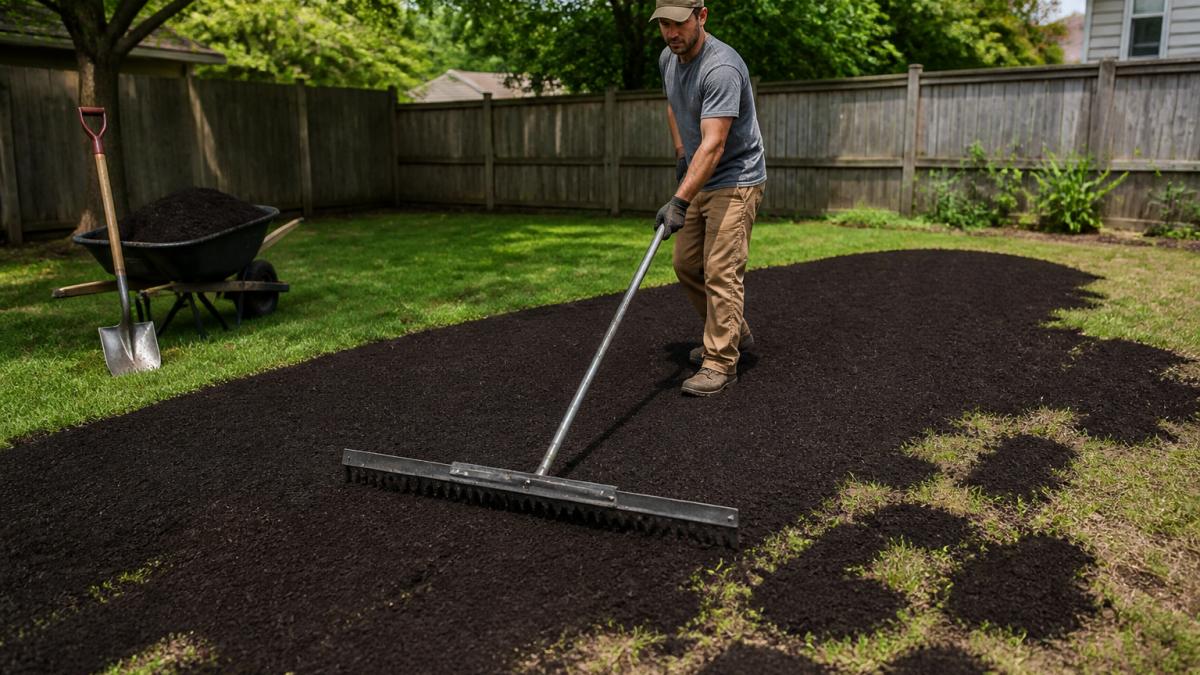
A lawn leveling rake is the tool that makes this job repeatable. It has a wide, flat head that skims soil off high spots and pushes it into dips.
Pick the Tool for Your Lawn Size and Budget
There is no single best tool; match it to the area and the volume of soil you are moving:
- Hand rake or landscape rake: cheapest option, fine for spot-filling a few dips under about 100 sq ft. Slow and hard to keep even over a whole lawn.
- Lawn leveling rake (wide flat head, often 30 to 48 inches): the workhorse for most homeowners. Covers ground fast, skims high spots, and pushes soil into dips. Best for lawns up to roughly a quarter acre.
- Drag mat or improvised drag (a section of chain-link, a weighted pallet, or a piece of artificial turf): follows the leveling rake to smooth the surface and press soil into the grass. Cheap to improvise; a dedicated drag mat is more consistent.
The Batch-and-Pass Method for Even Thickness
The mistake most people make is dumping one big mound and trying to push it across the lawn. That produces thick spots that smother grass and thin spots that do nothing. Instead, work in small batches and passes:
- Dump small piles. Drop shovelfuls or wheelbarrow loads in a grid across the low areas, roughly one pile every 6 to 8 feet, rather than one central mound.
- Work in one direction. Pull the leveling rake in long, even strokes across the whole area, spreading each pile into the next. Keep the head flat and let it skim, not dig.
- Change direction each pass. Make the second pass at roughly 90 degrees to the first so you catch ridges the first pass left behind.
- Follow with the drag mat. Drag in the same pattern to smooth the surface and press soil down into the turf.
- Check coverage, then refill. Walk the area and look for spots that still read low or high. Add small amounts to the low spots and repeat the pass.
How to Check Coverage as You Go
Even thickness is easier to verify than to eyeball. A few tricks:
- Look across the lawn at a low angle (crouch at one edge and sight along the surface), high and low spots show up as shadows and ridges.
- Use a straightedge. Lay a long board or a level across the area; gaps underneath show where soil is still low.
- Check the grass tips. After a thin pass, you should still see grass blades poking through the new layer. If the grass disappears, you went too thick.
Keep the layer thin. A leveling rake spreads soil better than a shovel ever will, and it shows you exactly where the surface is still uneven.
Watering In, Grass Recovery, and the Aftercare Timeline
Water right after you spread, and keep the new layer damp for the first two weeks. Deep, less frequent watering beats a daily sprinkle because it pushes moisture down to the roots.
Here is the aftercare timeline we recommend:
- Day 1: water until the new soil is soaked but not pooling
- Week 1-2: water every other day, keep the surface damp
- Week 3-4: grass should push through the thin layer; resume normal mowing
Skip mowing for the first two weeks. Then mow high and bag clippings for the first cut. Expect a repeat application on the worst spots, because soil settles as it knits into the turf.
Text a Photo and Get a Straight Quote for Your Leveling Job
Some leveling jobs are weekend projects. Others need real equipment and material. If your yard has deep dips, drainage problems, or debris to haul off, that may be a job for our team.
Text a photo of your project to request a quote. Current prices are on our pricing page.
Before you book, read our checklist on what to check before hiring a dirt hauler so you know what a fair quote looks like. Then look at our dirt work, grading, and small excavation service to see how we handle leveling jobs.
Request a free quote from NexGen Dirt & Haul to get started.
Frequently Asked Questions
Will grass grow through 2 inches of topsoil?
Most turfgrass will struggle through 2 inches of topsoil in one pass. Cool-season and warm-season grasses can usually push through about half an inch to 1 inch of a sandy loam mix without dying, but 2 inches smothers the crowns and invites disease. For dips deeper than an inch, fill in stages over several weeks during active growth, or dig out the sod, add soil underneath, and lay it back down.
How much topsoil should I spread over an uneven lawn?
For a thin leveling layer over existing grass, plan on a quarter inch to half an inch across the whole lawn, then spot-fill dips with up to 1 inch per application. To calculate volume, multiply lawn square footage by the depth in feet. A 5,000-square-foot lawn at half an inch needs roughly 7 cubic yards of leveling mix. Order a little extra for settling and low spots.
Can I level a lawn without killing the grass?
Yes, if you work during active growth and keep layers thin. Mow short first, spread a sandy loam or topsoil and sand mixture no deeper than half an inch over the existing turf, and work it into the grass with a leveling rake or drag mat. Water it in right away. Grass recovers fastest in spring or early fall when temperatures are moderate and rain is reliable.
Should I use topsoil, compost, or a soil mix to level my lawn?
Straight compost is too rich and holds too much moisture for leveling. Straight sand drains fast but stores almost no nutrients. The best soil for lawn leveling is a blend of about 60 to 70 percent sand and 30 to 40 percent topsoil or compost, which matches the texture of most existing lawns and lets roots knit through. Test your soil first so the mix you buy doesn't create a drainage problem.
